
A shrinking global population will force economic systems and governments to find radical solutions to prevent a collapse. After the fear of exploding population growth dominated the discussion last century, humanity is now faced with the opposite. More countries are struggling with shrinking populations. This situation forces governments to make decisions without knowing the full consequences. And it will affect every individual in various ways.
In this essay, we will explore three questions:
How did the population decline come about?
Why is this a problem?
And what does it mean for each individual?
How did the population decline come about?
While humanity has been growing for centuries, the numbers exploded in the last century.
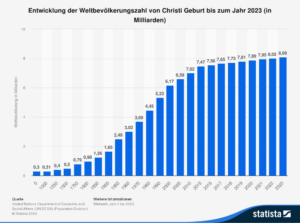
The reasons for growth are multifaceted, including industrialization, progress in food production and medicine. Industrialization improved the use of individual labor forces and increased output, particularly evident in agriculture, where fertilizers and machines not only increased yields on good soil but also made poor soil productive. This made more food available.
Before last century’s medical advancements, there was a high infant mortality rate, which necessitated many childbirths, as not all children survived. Additionally, there was no pension system, so parents relied on their children for support in old age. Before the development of child labor laws, children were essentially used as cost-effective workers. Child fertility was not only a social desire but also an economic necessity.
This explosive growth did not go unnoticed by demographers and was considered one of the great problems of the future. However, things always tend to turn out different than imagined or planned, and at the beginning of the new millennium, the growth rate began to decline. Scientists now commonly assume that the peak of 10 billion people will be reached around 2080.
But how did it came to this? Technological and societal change caused many economic reasons for having children not only to disappear but to turn into their opposites. Medical achievements, such as prophylactic vaccinations and improved hygiene conditions, dramatically reduced infant mortality. A state-regulated pension and care system reduced the dependence of parents on their children and ended the life in a large family. As a result, people were free to pursue work in the city. This, in turn, transformed child labor on the family farm into a cost per child. And no, that’s no argument for child labor. In Germany, parents typically spend around 730 euros on a child. In other countries, it’s similar. Additionally, there are the costs that the state incurs for supporting and educating a child paid by taxes. Furthermore, declining social acceptance of children, a lack of living space, and rising prices make it difficult or even impossible for some people to raise children.
Moreover, many couples simply didn’t want to have children, and don’t have to, thanks to numerous family planning options, such as contraception. This is only a few reasons why, in many countries, the fertility rate has fallen below the necessary number of 2.1 children per woman required to maintain population growth.
And this how the problem of overpopulation was solved.
Why is a shrinking population then such a problem?
In fact, there are three problems:
1. Insufficient birth rate to maintain current prosperity
2. Over-aging of society and
3. the Unbalanced shrinkage of population. And they are all interconnected.
But let’s start at the beginning.
Our economy is designed for growth. This is indicated by the GDP. Short for Gross Domestic Product. This can also be expressed as GDP per capita, which takes population size into account. But what happens if there are fewer people? Then the GDP decreases, and prosperity suffers, even though everyone works as much as before.
To prevent the economy from contracting into a recession, the GDP always needs to increase. This can only be achieved through two factors: an increase in the number of workers or an increase in labor productivity. How to achieve this is very diverse.
For example, to increase the output of an auto factory per worker, you can increase labor productivity by introducing new machines, train workers or extending working hours.
Another peculiarity is that the GDP per capita is calculated based on the entire population, including children, the sick, and the elderly, who do not or only marginally contribute to the GDP. The distribution of these population groups is shifting, with fewer children, fewer workers and more retirees. And this poses a second problem for the economy, but even more so for society.
Over the years, the care of the elderly has become increasingly the responsibility of the state, rather than the family. Pension, health, and care insurance are not designed for a large number of retirees. While some countries have systems where retirees receive their paid-in money back, many pension systems are based on a Pay-as-you-go pension, where today’s workers pay for the pensions of current retirees, hoping that future generations will also pay for their pensions. This system is based on the assumption that there will always be more children than retirees. However, with increasing life expectancy, this puts an additional burden on the pension system. The third problem is that the shrinking fertility rate affects many countries, but some African countries are seemingly bucking this trend, with more than a third of the 15-24-year-old population expected to live in Africa by 2050. This will lead to some power shifts and mass migrations within the global community.
So, how does this affect each individual?
Various solutions from the economy and government will fundamentally change our way of life. Depending on age, different effects will be experienced.
To slow down the transition of large numbers of workers to retirement, the retirement age may be raised. This would also shorten the duration of the retirement pension, which has become longer due to medical advancements. Healthcare and insurance fees will rise. In the care sector, many people with wealth will need to pay for themselves, which will particularly affect the middle class, leading to a reduction in their inheritance.
Some governments will also consider revoking the achievements and protection of children to make more workers available. For example, the USA has relaxed child labor regulations in recent years. This is not only a moral concern, but also essential to ensure that every worker earns more, as the GDP per capita must increase with a decreasing population. This will only be possible with better-trained workers. Pulling children out of the education system early or hindering their development is likely to be the wrong approach.
Immigration to industrialized countries will increase. This will lead to a whole bundle of own problems and challenges. It is also necessary to consider whether immigration makes economic sense, as it requires both highly skilled immigrants and their families, who may not work, and thus lower the GDP per capita.
Not to mention other problems, such as cultural differences, the recognition of certificates, and the fact that many industrialized nations are competing for the same group of workers. Countries may make it hard for well educated workers to leave.
The most obvious solution, increasing the birth rate, may be the most difficult to achieve. If women are not to be deprived of their right to self-determination, so that they are forced to bear children against their will, then raising a family will need to be re-prioritized in our society. Removing future concerns, housing shortages, and a lack of childcare facilities would be just the beginning. In general, motherhood or parenthood would need to be socially recognized and honored again.
So, what do you think? What would you change to face the demographic challenge?
Leave your comments below and tell me what you would change to address the demographic challenge.